

Introduction: From Struggling to Thriving
When Tyler Rablin, an author and a coach, started teaching, he faced a challenge that many new teachers know all too well: how to help students at different levels meet grade-level standards. How do you personalize instruction when everyone’s needs are different? And how do you create assessments that actually tell you what students have learned? At first, Rablin tried to handle these problems as they came up, reacting to each student’s struggle. But he soon realized there had to be a better way. What if, instead of constantly putting out fires, he could plan ahead? That’s when he discovered learning progressions, and everything changed.
Why Learning Progressions Matter
Backward design with learning progressions offers exactly that kind of proactive approach to a standard. Instead of guessing where students are headed, learning progressions show you the typical path students take as they learn. They help you understand each student’s “Zone of Proximal Development,” basically, what they’re ready to learn next, and guide them from complete beginner to expert.
So What Exactly Is a Learning Progression?
In their book, Assessment as a Catalyst for Learning, Garney Hillman and Mandy Stalets define learning progression pretty simply: it’s a series of achievement targets, basically, broken-down pieces of a priority standard, that teachers sequence from simplest to most complex.
Think of it as a road map for everyone, students, teachers, and teacher teams, showing how instruction and support will advance throughout the learning process. For students, especially, it’s a transparent outline of what they’re learning and what’s expected of them. (Hillman & Stalets, 2021)
How to Design Learning Progression
Here’s how Hillman and Stalets break it down: the assessment process starts with two key steps. You prioritize your priority standards. Then, you build learning progressions for those standards by creating and ordering specific goals from simplest to most complex. (Hillman & Stalets, 2021)
Step 1: Prioritize Standards
To figure out which standards deserve your focus on focus skills, consider these four characteristics:
Endurance: Does the standard endure throughout the school year or from year to year with vertical alignment?
Leverage: Does the standard include a skill or skills that cross over into other content areas?
Readiness: Does the standard include an essential skill or skills that students will need for the next grade level or course?
External exam requirements: Are there particular standards that are of high need for our learning community?
Here’s the good news: standards don’t need to check all four boxes to be prioritized. These are just ideas to help frame your decisions.
Step 2: Building Learning Progressions
From the " Moving Standards to Learning Targets” article, author Sara Needleman illustrated how she broke down the Standard Craft and Structure:
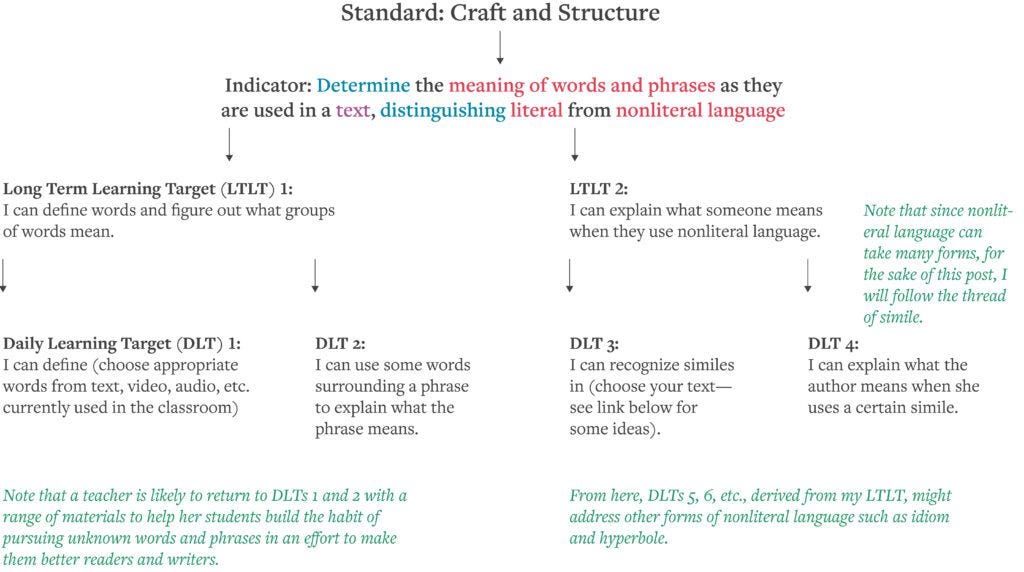
Needleman’s goal is to determine the instructional target(s); the target(s) to guide our daily planning and to share with students to guide their learning. In the graphic above, Needleman uses a third-grade CCSS literacy standard as an example of how she moves from a standard to an indicator to a long-term learning target (LTLT) to a daily learning target (DLT). The indicator is the only portion of the learning goal that came from a source other than her.
Organizing Learning Progressions
Hillman and Stalets provide four stages for creating Organizing Learning Progressions, a learning continuum:
(1) building readiness,
(2) exploring the learning goal,
(3) clarifying proficiency, and
(4) enriching understanding
Hillman and Stalets adopted this learning continuum from Katie White, author of Softening the Edges (2017). The learning continuum offers four levels that teachers can use to categorize specific goals within a progression and show how they are used in the classroom. This organization can be used no matter the length of the list of achievement targets.
Readiness-building targets: These targets address the prerequisite foundational skills, such as prior knowledge and vocabulary, that students should possess as they enter learning with the standard. The purpose of readiness-building targets is pre-assessment or early formative assessment to provide intervention and ensure readiness to engage with the new content and skills.
Exploration targets: These targets address the daily instruction and scaffolding at a lower Depth of Knowledge level than the standard requires (Webb, 2002). The purpose of these targets in the formative realm is to lay a solid foundation and provide intervention during early learning.
Proficiency targets: These targets outline the steps needed to develop proficiency with the standard. It is important to note that for summative purposes, the standard is what is assessed. The targets are the underpinnings needed to demonstrate proficiency in the larger skill. These targets are for formative use in the classroom (to provide feedback and ongoing intervention) and guide summative assessment (to put the targets back together to confirm that learning has occurred).
Targets for enriched understanding: These targets address a deeper understanding and skill level of the standard. These are written to address the question, What if students have already learned it? and offer teachers a shared understanding of how to allow for differentiation and challenge once learners are proficient. While the goal is proficiency with the standard, teachers set these targets to push students beyond it through further differentiation.
Here is an Example:
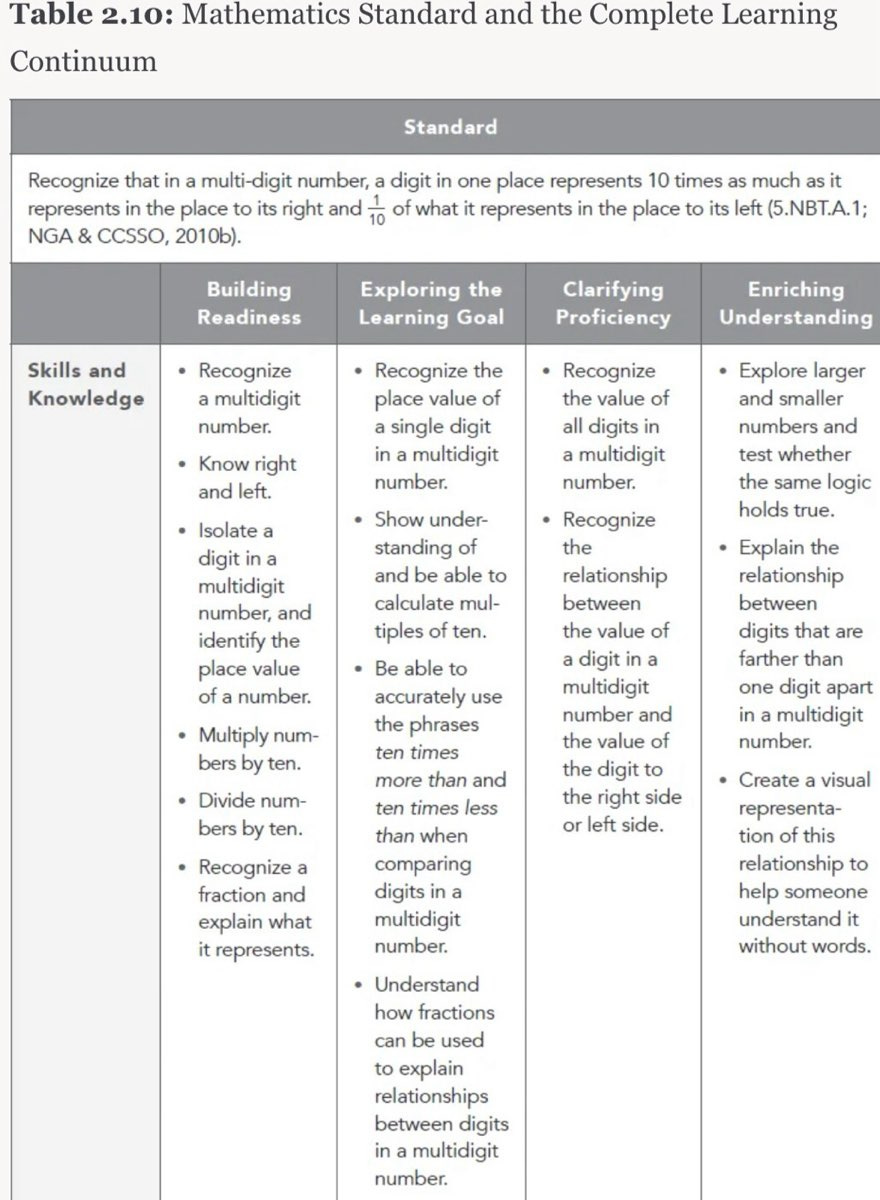
Source: Chapter 2 of Softening the Edges by Karen White
Rablin, author of The Power of Learning Progressions, suggests focusing on the following questions whenever you create a learning progression:
Phase 1 and 2: What background knowledge do I assume students are coming to me with? My goal is to identify the basic background concepts and knowledge and skills in the learning progression early on, so that a student who comes to me with gaps in their knowledge from previous years can identify what they need to focus on to get up to speed.
Phase 3: What new concepts will students need to learn? Standards are often complex and difficult to understand, especially for students who already struggle with the content. As such, I focus on taking those bulky standards and clearly identifying the new concepts embedded within them.
Phase 4: How will students apply this new content? This is where we start combining the content embedded in the standard with the knowledge and skills it includes.
Phase 5: How will students make connections with this content? I usually think about how this content is interconnected with other content. I help students take a concept they learned in isolation and apply it to a more complex scenario where they need to think through a variety of factors.
Rablin explains that learning progression serves a few purposes:
It helps me anticipate what elements might be involved in my differentiation.
It can be used by students like a hiker uses a map to help them course-correct when they are stuck or lost.
It creates a vehicle to help me package resources and supports for students as they make decisions about their learning.
Rablin prints out these learning progressions and uses them as my daily learning targets to help create more cohesion (and because Rablin didn't want to rewrite them every day).
Learning Progression Language
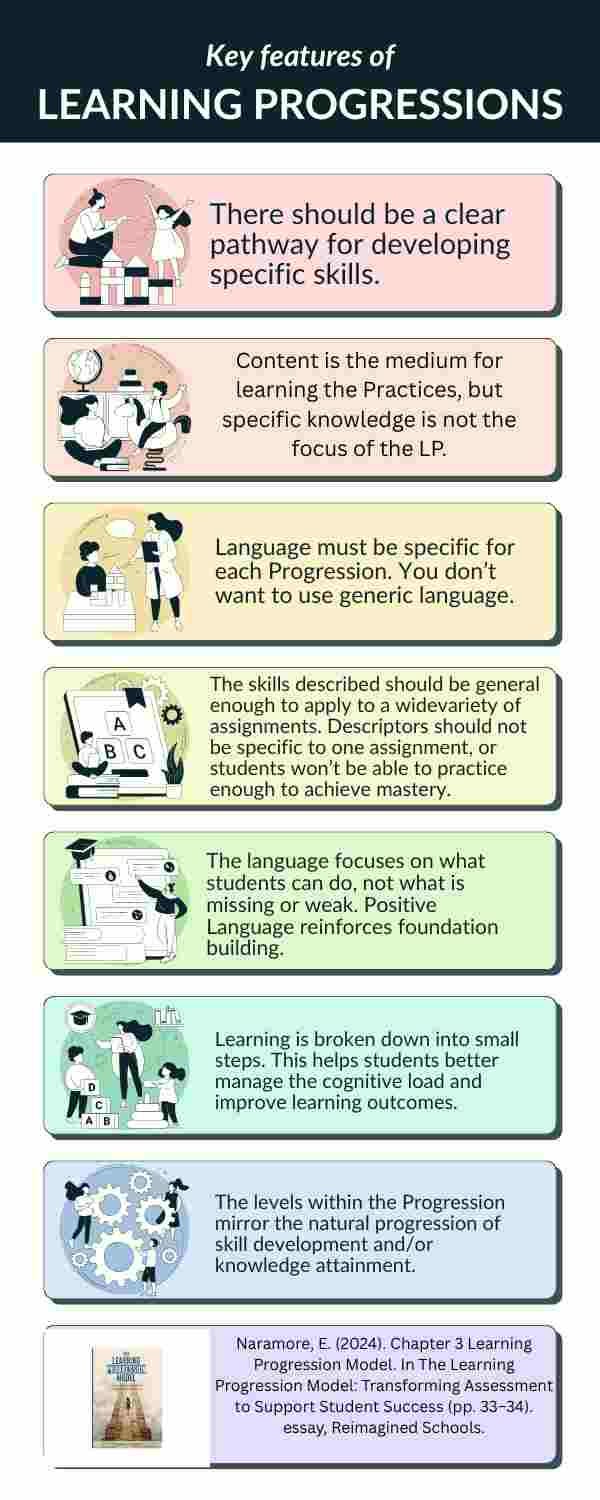
Elise Naramore, author of The Learning Progression Model, describes seven key features of a Learning Progression (LP), which you can see in the infographic above. She emphasizes that when we use clear, straightforward language, break tasks into smaller steps, and keep the level of difficulty consistent through levels of complexity, the path to success is much easier for students to follow. It’s not an instant fix, though; Naramore points out that it takes time and effort to really organize and fine-tune this approach, but she argues it’s well worth that investment.
In the section above, the How to Maintain Consistent Achievement Levels across Learning Progressions Chart has two main columns.
Achievement Level Name
This column describes the knowledge, skills, and/or processes students show for a particular practice. Naramore has found that six achievement levels work well for both students and teachers. The levels are:
Not enough evidence
Developing - Proficient
Advanced
Expert
You might be wondering, why have so many levels? Naramore explains that this structure helps students (and parents) see students' actual progress. Students benefited from smaller, more specific steps, and she wanted the rubric to offer enough detail to truly guide them.
The rubric also needed to be easy to read and understand. Naramore planned to use Learning Progressions across many different courses, each with its own pace, starting skills, and expectations. She believes that this kind of differentiation simply wouldn’t be possible with fewer than six levels, allowing for alternate assessment in varied contexts.
That said, Naramore emphasizes this is not a mandate. You will adjust and name your levels to fit your students’ needs and your course requirements.
Anchor Words
Anchor words are used to keep the progressions consistent and the feedback steady over time. Naramore cites Wiggins (2012):
“To be useful, feedback must be consistent. Performers can only adjust their performance successfully if the information they receive is stable, accurate, and trustworthy. In education, that means teachers have to be on the same page about what high-quality work is.”
To support this, Naramore assigns anchor words to each developmental level of the Learning Progressions. In the chart, each level has an anchor word (highlighted in red) that helps keep our interpretation consistent.
These anchor words reinforce what each achievement level is meant to represent. For example, a proficient response uses correct physics concepts, such as when interpreting a graph or analyzing data, even if the student’s application of those concepts is not fully correct.
The “Not enough evidence” level is the only one that lacks an anchor word. When a student doesn’t provide enough work (or doesn’t turn in an assignment or answer a question), there simply isn’t a basis for giving feedback about whether they have mastered any part of that Practice.
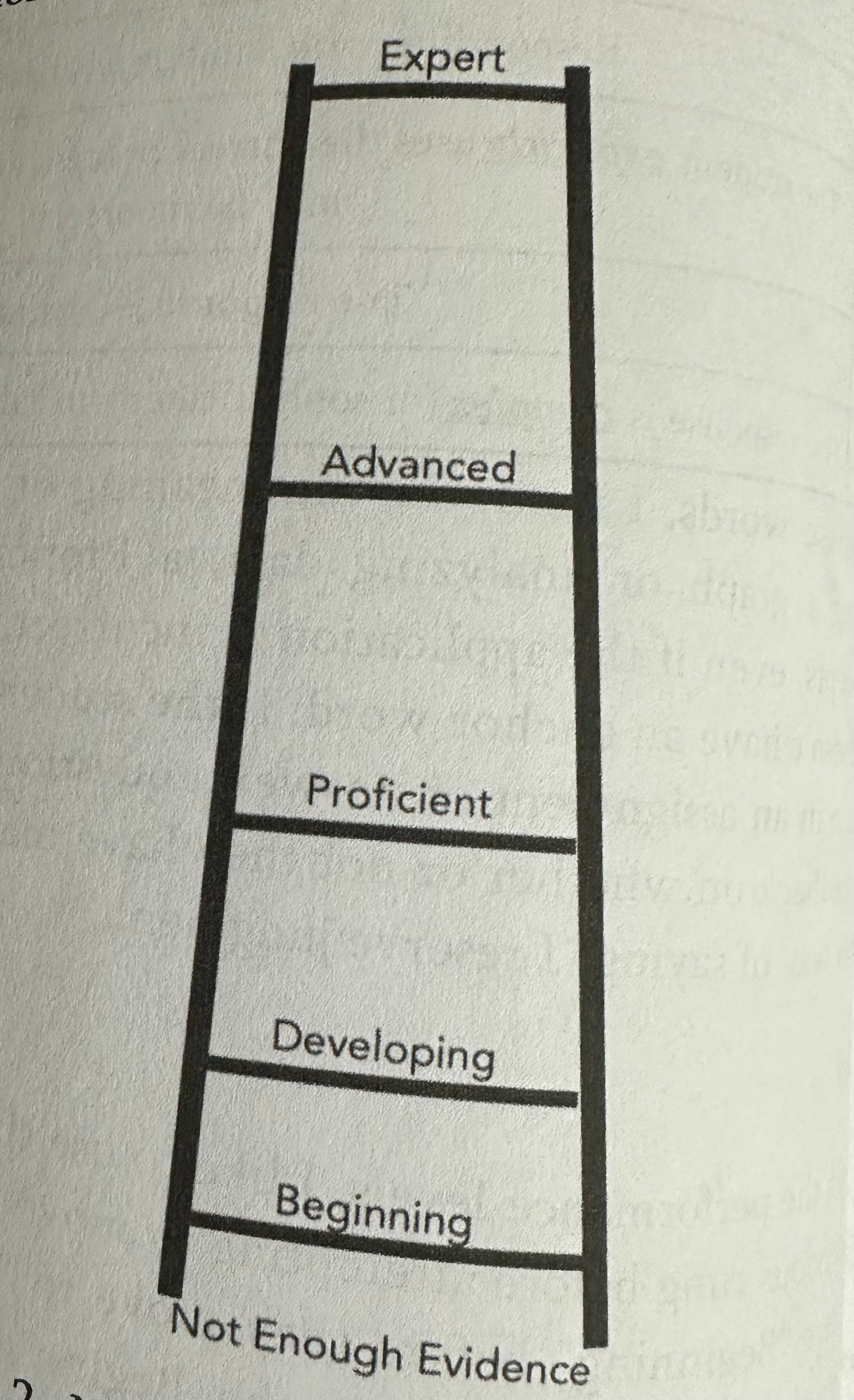
The Ladder Analogy
Source: Naramore, E. (2024). The Learning Progression Model: Transforming Assessment to Support Student Success. (pp.37-37)
To make sense of the performance levels, Naramore uses a ladder analogy. You can think of each performance level as a rung on a ladder: you have to stand firmly on one rung before you can safely move up to the next. So students need to reach the “Beginning” level before they can move on to “Developing.” If they haven’t met the requirements for “Beginning,” they can’t really be considered “Developing” yet.
Naramore also points out that the Beginning level has to be simple and accessible so every student can get started through entry points and feel some success. At the same time, students who are ready for more challenging work need space to show that too. This is what Naramore calls a “low floor, high ceiling” approach aligned with universal design for learning: it’s easy to step in, but there’s plenty of room for students to grow and be challenged. Naramore sees this flexibility and built-in differentiation as one of the biggest strengths of the Learning Progression Model, including support for students with significant cognitive disabilities via access points to the general education curriculum.
Now, picture the Learning Progression Ladder. Unlike a real ladder, the rungs here aren’t evenly spaced. The gaps between levels change. As you move into higher levels of complexity, the work gets harder to manage. Because of that, the class usually moves pretty quickly from the introductory level up to Developing. After that, though, Naramore stresses that much more time is spent helping students reach Proficient, and even more time is needed for them to reach an Advanced level of mastery.
The Use of Learning Progression
Hillman and Stalets explain that learning progressions serve two purposes:
It provides for tight alignment with the learning that will build proficiency toward the standards.
And learning progressions serve as a daily guide for formative assessment.
Teachers must make Learning Progressions visible to students. Whether they post the progressions in the classroom, use them for pre-assessment at the outset of new learning, or include achievement targets from them at the top of an assignment, students must see them and have access to them.
Hillman and Stalets emphasize that students and teachers must interact with the specific goals for them to be useful. It is best that teachers consistently remind students of the skills they are working on through explicit instruction and how those skills contribute to achieving the standard overall.
The more teachers use learning progressions meaningfully in the classroom, the easier it will be for students to achieve them. This ensures there is no confusion about which knowledge, understandings, and skills students are developing and what evidence will demonstrate proficiency.
With the learning progression in place, teachers can begin to consider how the assessment process will work and ensure that students are engaged.
Building the Assessment Process
Hillman and Stalets describe learning progressions as doing two big jobs in the classroom: they keep instruction closely aligned to the skills students need to reach the standards, and they act as a day-to-day guide for formative assessment (Hillman & Stalets, 2022, pp. 49–50). In other words, they’re not just planning tools for teachers; they’re meant to shape what happens with students every day through classroom assessments.
For that to happen, students actually have to see and use the learning progressions. Hillman and Stalets point out that teachers need to make them visible and accessible, whether that means posting them in the classroom, using them as a preassessment at the start of a new unit, or placing the achievement targets from the progression at the top of an assignment (pp. 49–50). It isn’t enough for progressions to live in a binder or in a lesson plan. Students need regular access to them so they can understand what they’re working toward and see clear evidence of student learning.
They also stress that both teachers and students must actively engage with the specific goals for them to matter. That might look like teachers frequently reminding students of which specific skills they’re practicing, or explicitly connecting those skills back to the larger standard. When teachers keep looping back to the progression and using it meaningfully, students are more likely to understand it and actually reach those targets (Hillman & Stalets, 2022, pp. 49–50). This kind of transparency cuts down on confusion about what knowledge, skills, and understandings students are expected to develop, and what will count as evidence of proficiency. Once the learning progression is clearly laid out, teachers can begin considering how their assessment process will work and how to ensure students are genuinely invested in it.
Hillman and Stalets (2022) also bring in the work of Cassandra Erkens, Tom Schimmer, and Nicole Dimich from Essential Assessment to reinforce an important idea based on research-based guidelines: assessment should be seen as an ongoing process, a verb, not just a noun (pp. 49–50). It’s fluid. It connects formative and summative assessment rather than treating them as entirely separate events. Within this ongoing process, learning progressions become key drivers of student learning.
When assessment tools and routines are aligned with the achievement targets in the progression, the evidence students produce is much clearer. Teachers can actually see whether students are meeting specific goals, and students can see it too. The progression then guides both instruction and student practice. From that point, teachers can draw on what Hillman and Stalets call the “architecture of assessment” to design or adapt tools that fit where students are along the progression (2022, pp. 49–50).
As students progress, it should build their confidence. The most complex targets, near the end of the progression, should start to resemble what students will eventually be asked to do on summative assessments (Hillman & Stalets, 2022, pp. 49–50). Teachers aren’t typically lifting the smallest skills directly from the progression and turning them into summative test items, but those smaller skills still matter. They prepare students so that, by the time they reach the summative stage, they’re ready for the greater, more complex demands, including adaptations like extended standards.
This idea fits with the notion that assessment should be planned before instruction begins. Learning progressions support that kind of backward design very naturally. At the same time, Hillman and Stalets acknowledge that not every assessment opportunity will be preplanned; teachers will also gather evidence in more informal ways, such as during quick one-on-one conferences or spontaneous checks in class (2022, pp. 49–50). Just as the specific goals increase in complexity as they move toward the full standard, teachers’ planning around assessment, instruction, and practice needs to grow in sophistication too, so that all of these pieces stay connected to the progression and to one another.
Student Growth Journey
Learning progressions don’t just show students where they’re going; they also help them see the steps they’ll need to take along the way. Hillman and Stalets (Assessment as a Catalyst for Learning, pp. 52–53) explain that when students receive both a learning progression and a tool for reflection, they begin to view their learning as a journey they can follow and understand, supporting goals in an individualized education program.
Take their example of a second-grade social studies class. At the start of a new unit, the teacher gives students the learning progression along with a simple reflection tool (See below). As they move through the unit, students are asked to think back on what they did in class and mark when they feel they’ve met certain achievement targets. Over time, they’re not just doing activities; they’re paying attention to what they’re learning from those activities.
Younger students usually need quite a bit of support at first, lots of modeling, reminders, and guided practice using the tools. Hillman and Stalets note that this support is important early on (pp. 52–53), but as students become familiar with the process, they can take on more responsibility themselves. Older students tend to pick up the structure more quickly, though they may still need nudges to use it consistently rather than set it aside.
Reference
Hillman, Garnet, & Stalets, M. (2022). Assessment as a catalyst for learning: Creating a responsive and fluid process to inspire all students. Solution Tree Press.
Needleman, S. (February 27, 2026). Moving from standards to learning targets. JumpRope. https://jumpro.pe/moving-from-standards-to-learning-targets/
Rablin, T. (October 7, 2024). The power of Learning Progressions. Edutopia. https://www.edutopia.org/article/learning-progressions-differentiation
Naramore, E. (2024b). Chapter 3 Learning Progression Model. In The Learning Progression Model: Transforming Assessment to Support Student Success (pp. 37–38). essay, Reimagined Schools.
Years after learning about SBG from the likes of Ken O'Connor and Matt Townsley, I came to realize the next evolutionary step was to redesign this material to develop self-directed learners, shifting away from the way we develop resources for teachers to be discussed with other teachers for our own professional development (a necessary first step), and more toward how we develop learning spaces for students to discuss with other students for their own developing sense of awareness, direction, and purpose. I'm super excited to see more people engaging with standards-based (and competency-based) education principles! 🥳